
Oral Cancer Screenings: Why They Matter and How Early Detection Can Save Lives
Oral cancer and other cancers of the head and neck can grow in places that are hard to see on your own. These areas include the sides and underside of the tongue, the floor of the mouth, and the back of the throat.1 Because these cancers may not cause clear symptoms at first, finding them early is very important. Early detection can lead to better treatment results, which is why regular oral cancer screenings are an important part of preventive dental care.1
What is an oral cancer screening?
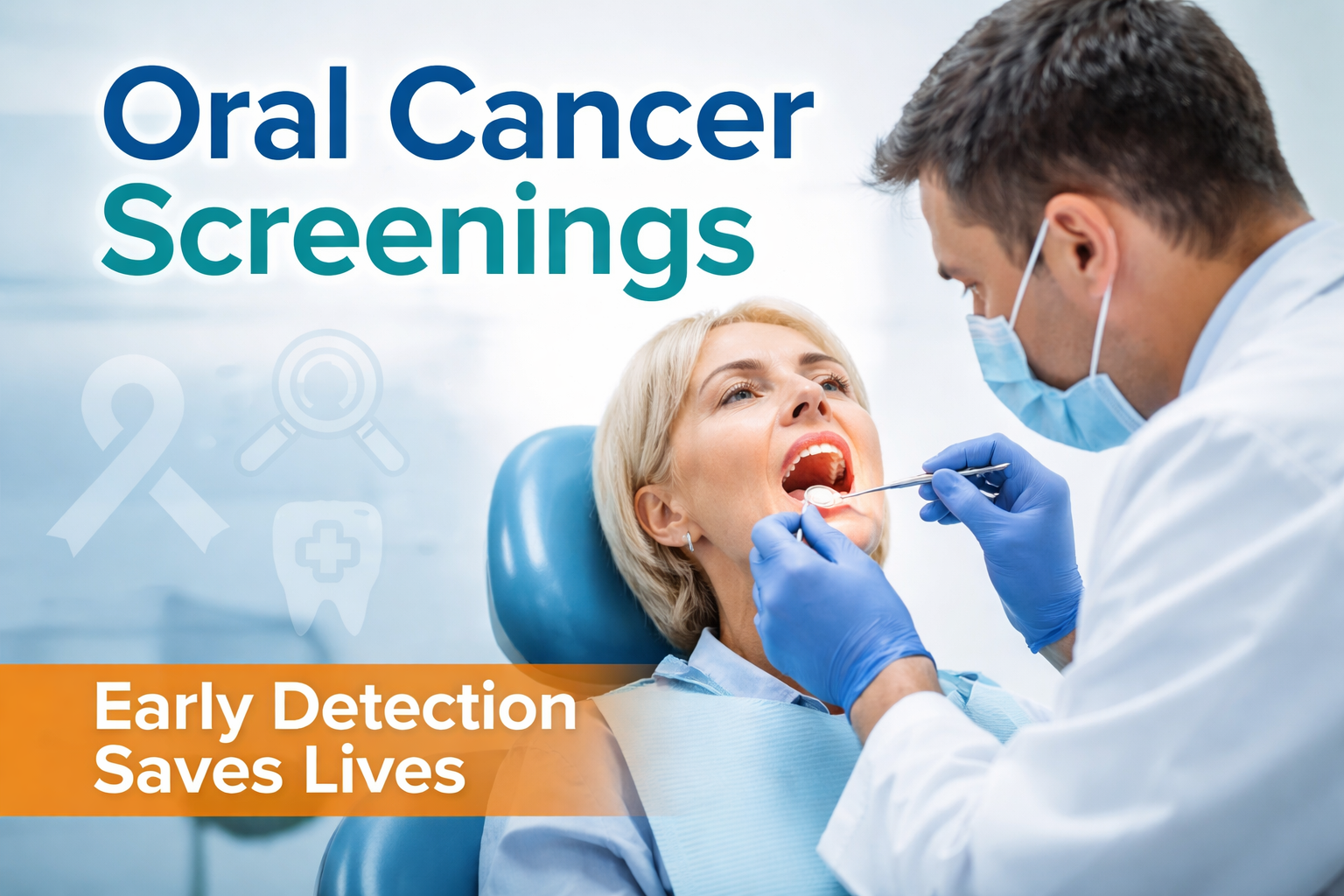
An oral cancer screening is a careful check of your mouth and nearby areas. During the exam, a dental professional looks at and feels different parts of your mouth and neck. This includes your lips, cheeks, gums, tongue, floor of the mouth, roof of the mouth, throat area, and the lymph nodes in your neck.(1,2)
The American Dental Association (ADA) says dental professionals should examine both inside and outside the mouth and take action if they find anything unusual. This may include doing a biopsy or sending you to a specialist. (3,4) The National Institute of Dental and Craniofacial Research (NIDCR) explains that oral cancer screenings can be done during regular dental checkups. (1,2)
Why routine screening matters
Oral cancer in its early stages may be hard to notice. Changes can be small or look harmless, which means people may not realize anything is wrong.5 Without a professional exam, diagnosis can be delayed.
The American Association of Oral and Maxillofacial Surgeons (AAOMS) explains that regular screenings help find areas that need closer attention, monitoring, or testing before they become more serious. (5)
Risk factors that increase the importance of screening
Much like other forms of cancer, certain individuals have a higher risk of developing oral cancer based on certain habits and health history, such as:
- Using tobacco products, which strongly increases cancer risk (6,7)
- Drinking alcohol, especially when combined with tobacco use (6)
- Infection with human papillomavirus (HPV), especially HPV-(1,6,8)
- Smoking, which raises cancer risk in several parts of the head and neck (7)
How often should patients have oral cancer screenings performed?
Experts agree that oral cancer screening should be part of regular dental care. The American Academy of Oral Medicine (AAOM) states that examining the mouth and checking risk factors should be part of routine dental visits (9,10) The ADA supports regular visual and physical exams of the mouth (3,4) The NIDCR states that dental visits are an appropriate time for oral cancer screening, (1) Most people should receive an oral cancer screening during routine dental visits based on their normal checkup schedule. People at higher risk may need to be checked more often, depending on their dental professional’s judgment. (3,4,9,10)
Survival: why early detection changes outcomes
- Large cancer databases show that people diagnosed with oral cancer at an earlier stage have much higher survival rates.
- According to NIDCR data (2012–2018), 5-year relative survival rates for oral cancer are:
- Cancer found only in the original location: 86.3%
- Cancer spread to nearby areas: 69.0%
- Cancer spread to distant parts of the body: 40.4%
- All stages combined: 68.0%13
- The American Cancer Society reports similar patterns for specific cancers. For example:
- Tongue cancer: 88% survival when localized vs 39% when spread distantly (11)
- These numbers show how strongly survival depends on how early cancer is found. (11,12)
What patients should watch for between visits
You should seek evaluation if any of the following symptoms last more than two weeks:
- Sores that do not heal
- Red or white patches
- Unexplained lumps
- Numbness
- Trouble swallowing
- Ongoing voice changes (5)
Oral cancer screening is a simple and non-invasive exam that fits easily into routine dental care. (1–5) Dental and surgical organizations support regular screenings with risk assessment as standard clinical practice. (3–5,9,10)
Survival data clearly show that cancer found early is much more treatable, which is why early detection is so important. (11,12)
At Jay Platt, DDS Oral Surgery & Dental Implant Center, oral cancer screenings are part of comprehensive oral examinations to help detect problems early, support timely diagnosis, and improve long-term health outcomes.
REFERENCES
- National Institute of Dental and Craniofacial Research. Oral Cancer. NIH. Accessed Jan 28, 2026. https://www.nidcr.nih.gov/health-info/oral-cancer
- National Institute of Dental and Craniofacial Research. Detecting Oral Cancer: A Guide for Health Care Professionals. NIH. https://www.nidcr.nih.gov/sites/default/files/2020-10/Detecting-Oral-Cancer-Healthcare-Professionals.pdf
- 3. American Dental Association. Evidence-Based Clinical Practice Guideline for the Evaluation of Potentially Malignant Disorders in the Oral Cavity. https://www.ada.org/resources/research/science/evidence-based-dental-research/oral-cancer-guideline
- American Dental Association. Chairside Guide: Oral Cancer. https://www.ada.org/-/media/project/ada-organization/ada/ada-org/files/resources/research/10870a_chairside_guide_oralcancer_final.pdf
- American Association of Oral and Maxillofacial Surgeons. Head and Neck Cancer Screening and Prevention: Position Paper. https://aaoms.org/wp-content/uploads/2024/03/HeadNeckCancerScreening_PositionPaper.pdf
- Centers for Disease Control and Prevention. About Oral Cancer. https://www.cdc.gov/oral-health/about/about-oral-cancer.html
- National Cancer Institute. Oral Cavity and Oropharyngeal Cancer Prevention (PDQ®). https://www.cancer.gov/types/head-and-neck/hp/oral-prevention-pdq
- Centers for Disease Control and Prevention. HPV and Oropharyngeal Cancer. https://www.cdc.gov/cancer/hpv/oropharyngeal-cancer.html
- American Academy of Oral Medicine. Clinical Practice Statement: Oral Cancer Screening. https://www.aaom.com/clinical-practice-statement–oral-cancer-screening
- Kerr AR, et al. Oral cancer screening: Evidence-based clinical practice statement. Oral Surg Oral Med Oral Pathol Oral Radiol. 2016. https://www.oooojournal.net/article/S2212-4403(16)30026-8/fulltext
- American Cancer Society. Survival Rates for Oral Cavity and Oropharyngeal Cancer. https://www.cancer.org/cancer/types/oral-cavity-and-oropharyngeal-cancer/detection-diagnosis-staging/survival-rates.html
- National Institute of Dental and Craniofacial Research. Oral Cancer Survival Rates (SEER-based). https://www.nidcr.nih.gov/research/data-statistics/oral-cancer/survival-rates
Comments are closed.