
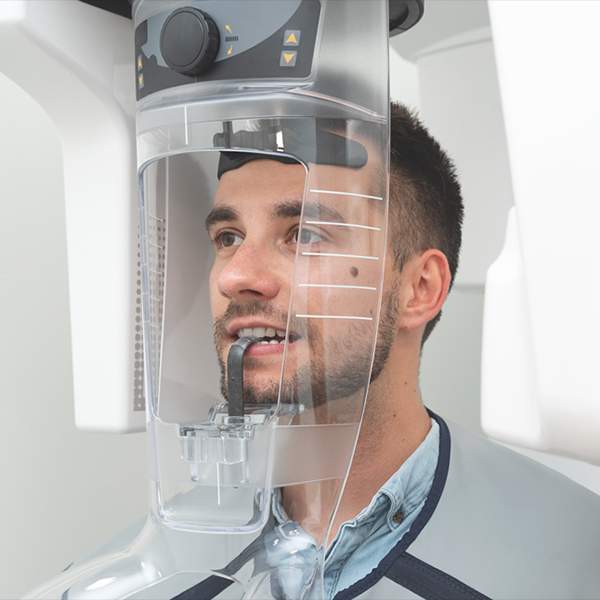
Bone Grafting Benefits for Dental Implants and Oral Health
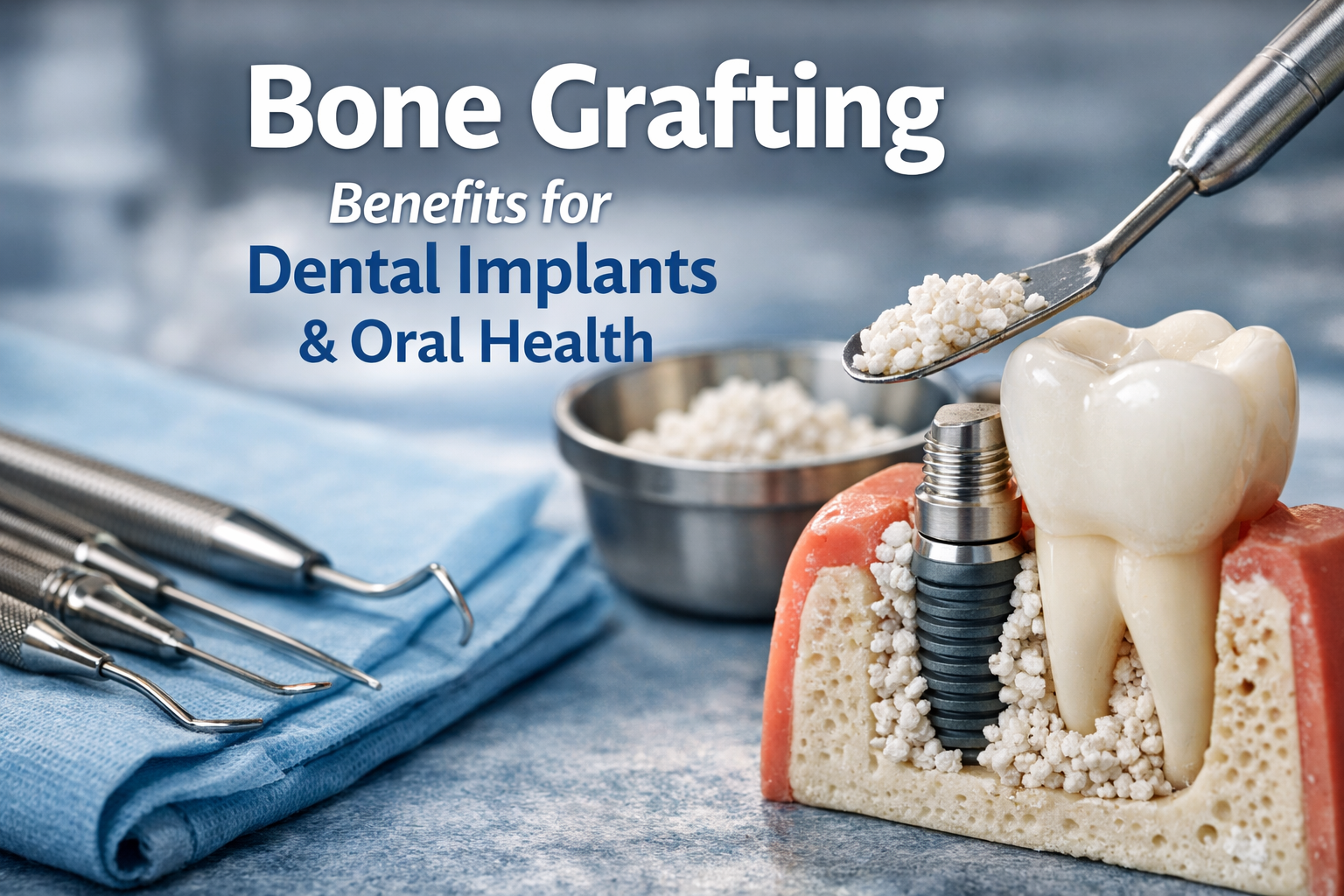
When a tooth is removed—or lost due to disease or trauma—the jawbone in that area predictably remodels and resorbs.¹ This is not a rare complication; it’s a normal biologic response to loss of the tooth and its supporting structures.¹ In human studies, the alveolar ridge commonly loses more width than height, and clinically meaningful dimensional change can occur within the first several months after extraction.¹
Bone grafting is used in oral surgery and implant care to preserve existing bone where loss is expected, and to rebuild bone where insufficient volume would limit predictable implant placement.2-6 The overall goal is to maintain (or restore) the bone volume needed for stable function, long-term maintenance, and—when relevant—natural-looking esthetics.1-6
Why bone loss after extraction matters
Systematic evidence shows that post-extraction remodeling can significantly reduce ridge dimensions, especially ridge width, and this can directly affect future treatment options.¹ Reduced ridge width and height can complicate implant placement position and angulation, potentially requiring additional augmentation procedures later.1-6
Benefit 1: Ridge preservation reduces the amount of bone lost after extraction
Alveolar ridge preservation (ARP)—often called “socket grafting”—places graft material into the extraction socket to help limit the degree of ridge collapse during healing.2-4
Multiple systematic reviews and meta-analyses show that, compared with extraction alone, ARP reduces post-extraction dimensional changes in ridge width and height.2,3 Importantly, the evidence also supports that no grafting material fully prevents physiologic remodeling, but ARP consistently results in less bone loss than spontaneous (unassisted) healing.⁴
Clinical takeaway: If an implant may be desired in the future, ridge preservation can help maintain the bone “real estate” needed for simpler and more predictable implant planning.2-4
Benefit 2: Bone grafting expands dental implant eligibility
Dental implants require adequate bone volume for appropriate placement and long-term support.5,6 When bone is deficient, guided bone regeneration (GBR) or ridge augmentation can reconstruct the site so an implant can be placed in a more ideal position.5,6
Systematic reviews evaluating implants placed in sites treated with GBR report favorable implant survival outcomes across many included studies, and controlled trials in this literature have not consistently shown survival disadvantages compared with implants placed in non-regenerated sites, although outcomes vary by defect type, technique, and follow-up duration.5,6
Clinical takeaway: Bone grafting can convert a “not enough bone” site into one that can reliably support an implant.5,6
Benefit 3: Better implant positioning, prosthetic design, and hygiene access
Maintaining or rebuilding ridge dimensions supports implant placement in a position that helps the restoration function properly and remain cleanable.1-6 Ridge collapse can force compromises in implant position and prosthetic contours, which can affect long-term maintenance.1-6
Clinical takeaway: Bone grafting is often a “prevention step” that supports restoration design and maintenance—not just the surgery itself.1-6
Benefit 4: Earlier grafting can reduce the need for more complex reconstruction later
Vertical bone loss (loss of ridge height) is generally more challenging to correct than horizontal loss.7-8Systematic reviews show that vertical ridge augmentation can achieve meaningful bone gain but carries higher complication risk and greater technique sensitivity than simpler preservation procedures.7-8
Because ridge preservation reduces the amount of post-extraction collapse, and vertical augmentation is more complex and complication-prone, earlier intervention is often used clinically to reduce the likelihood that advanced reconstruction is needed later (an evidence-based inference grounded in these findings).2-4,7,8
Clinical takeaway: If preserving bone now can prevent advanced grafting later, it may reduce overall surgical burden.2-4,7,8
Benefit 5: Sinus augmentation enables implants in the upper back jaw when anatomy limits bone height
In the posterior maxilla (upper back jaw), available bone height is frequently limited by the maxillary sinus. Sinus floor elevation procedures can create bone volume for implant placement in that region.9-11
Systematic reviews and meta-analyses report high implant survival following sinus floor elevation across techniques, supporting sinus grafting as a predictable approach for developing implant sites in anatomically limited areas.9-11
Clinical takeaway: When the sinus limits implant height in the upper back jaw, grafting can safely expand implant options.9-11
What this means for patients
Bone grafting is best viewed as protecting options and improving predictability. The evidence consistently supports that:
- Post-extraction ridge collapse is expected and clinically meaningful.¹
- Ridge preservation reduces the amount of bone lost versus extraction alone.2-3
- No graft eliminates resorption completely, but preservation reduces it.⁴
- GBR/augmentation can support implants in sites that lack adequate bone.5-6
- Vertical augmentation is effective but more complex and complication-prone.7-8
- Sinus augmentation supports predictable implant placement when anatomy limits bone height.9-11
At Jay Platt, DDS Oral Surgery & Dental Implant Center, bone grafting recommendations are based on imaging, site anatomy, medical history, and the long-term restorative plan—so treatment decisions are driven by predictability and long-term outcomes. Contact us today to see if bone grafting is right for you!
References (AMA with digital links)
1. Tan WL, Wong TLT, Wong MCM, Lang NP. A systematic review of post-extractional alveolar hard and soft tissue dimensional changes in humans. Clin Oral Implants Res. 2012;23(Suppl 5):1-21. doi:10.1111/j.1600-0501.2011.02375.x. PubMed: https://pubmed.ncbi.nlm.nih.gov/22211303/ Publisher: https://onlinelibrary.wiley.com/doi/10.1111/j.1600-0501.2011.02375.x
2. Ávila-Ortiz G, Elangovan S, Kramer KWO, Blanchette D, Dawson DV. Effect of alveolar ridge preservation after tooth extraction: a systematic review and meta-analysis. J Dent Res. 2014;93(10):950-958. doi:10.1177/0022034514541127. PMC: https://pmc.ncbi.nlm.nih.gov/articles/PMC4293706/ PubMed: https://pubmed.ncbi.nlm.nih.gov/24966231/
3. Ávila-Ortiz G, Chambrone L, Vignoletti F. Effect of alveolar ridge preservation interventions following tooth extraction: a systematic review and meta-analysis. J Clin Periodontol. 2019;46(Suppl 21):195-223. doi:10.1111/jcpe.13057. PubMed: https://pubmed.ncbi.nlm.nih.gov/30623987/ Publisher: https://onlinelibrary.wiley.com/doi/10.1111/jcpe.13057
4. Stumbras A, Kuliesius P, Januzis G, Juodzbalys G. Alveolar ridge preservation after tooth extraction using different bone graft materials and autologous platelet concentrates: a systematic review. J Oral Maxillofac Res. 2019;10(1):e2. doi:10.5037/jomr.2019.10102. PubMed: https://pubmed.ncbi.nlm.nih.gov/31069040/ PMC: https://pmc.ncbi.nlm.nih.gov/articles/PMC6498816/
5. Hämmerle CHF, Jung RE, Feloutzis A. A systematic review of the survival of implants in bone sites augmented with barrier membranes (guided bone regeneration) in partially edentulous patients. J Clin Periodontol. 2002;29(Suppl 3):226-231. doi:10.1034/j.1600-051X.29.s3.14.x. PubMed: https://pubmed.ncbi.nlm.nih.gov/12787222/ Publisher: https://onlinelibrary.wiley.com/doi/10.1034/j.1600-051X.29.s3.14.x
6. Chiapasco M, Zaniboni M. Clinical outcomes of GBR procedures to correct peri-implant dehiscences and fenestrations: a systematic review. Clin Oral Implants Res. 2009;20(Suppl 4):113-123. doi:10.1111/j.1600-0501.2009.01781.x. PubMed: https://pubmed.ncbi.nlm.nih.gov/19663958/ Publisher: https://onlinelibrary.wiley.com/doi/10.1111/j.1600-0501.2009.01781.x
7. Urban IA, Monje A, Wang HL. Effectiveness of vertical ridge augmentation interventions: a systematic review and meta-analysis. J Clin Periodontol. 2019;46(Suppl 21):319-339. doi:10.1111/jcpe.13061. PubMed: https://pubmed.ncbi.nlm.nih.gov/30667522/ Publisher: https://onlinelibrary.wiley.com/doi/10.1111/jcpe.13061
8. Sáez-Alcaide LM, et al. Complications associated with vertical bone augmentation procedures prior to implant placement: a systematic review. J Prosthodont Res. 2023. ScienceDirect: https://www.sciencedirect.com/science/article/pii/S2468785523001957
9. Shah D, Chauhan C, Shah R, Solanki J. Survival rate of dental implant placed using various maxillary sinus floor elevation techniques: a systematic review and meta-analysis. J Indian Prosthodont Soc. 2022. PubMed: https://pubmed.ncbi.nlm.nih.gov/36511050/ PMC: https://pmc.ncbi.nlm.nih.gov/articles/PMC9416960/
10. Kadkhodazadeh M, et al. Clinical outcomes of implants placed with transcrestal maxillary sinus elevation: a systematic review and meta-analysis. Clin Oral Investig. 2024. PubMed: https://pubmed.ncbi.nlm.nih.gov/39098575/ ScienceDirect: https://www.sciencedirect.com/science/article/abs/pii/S0266435624001177
11. Saleh MHA, et al. Clinical indications and outcomes of sinus floor augmentation with bone substitutes: an evidence-based review. Clin Implant Dent Relat Res. Epub 2024 Oct 17; published 2025. doi:10.1111/cid.13400. PubMed: https://pubmed.ncbi.nlm.nih.gov/39415739/ PMC: https://pmc.ncbi.nlm.nih.gov/articles/PMC11789849/
Comments are closed.