

Do I Need a Bone Graft Before Getting a Dental Implant?
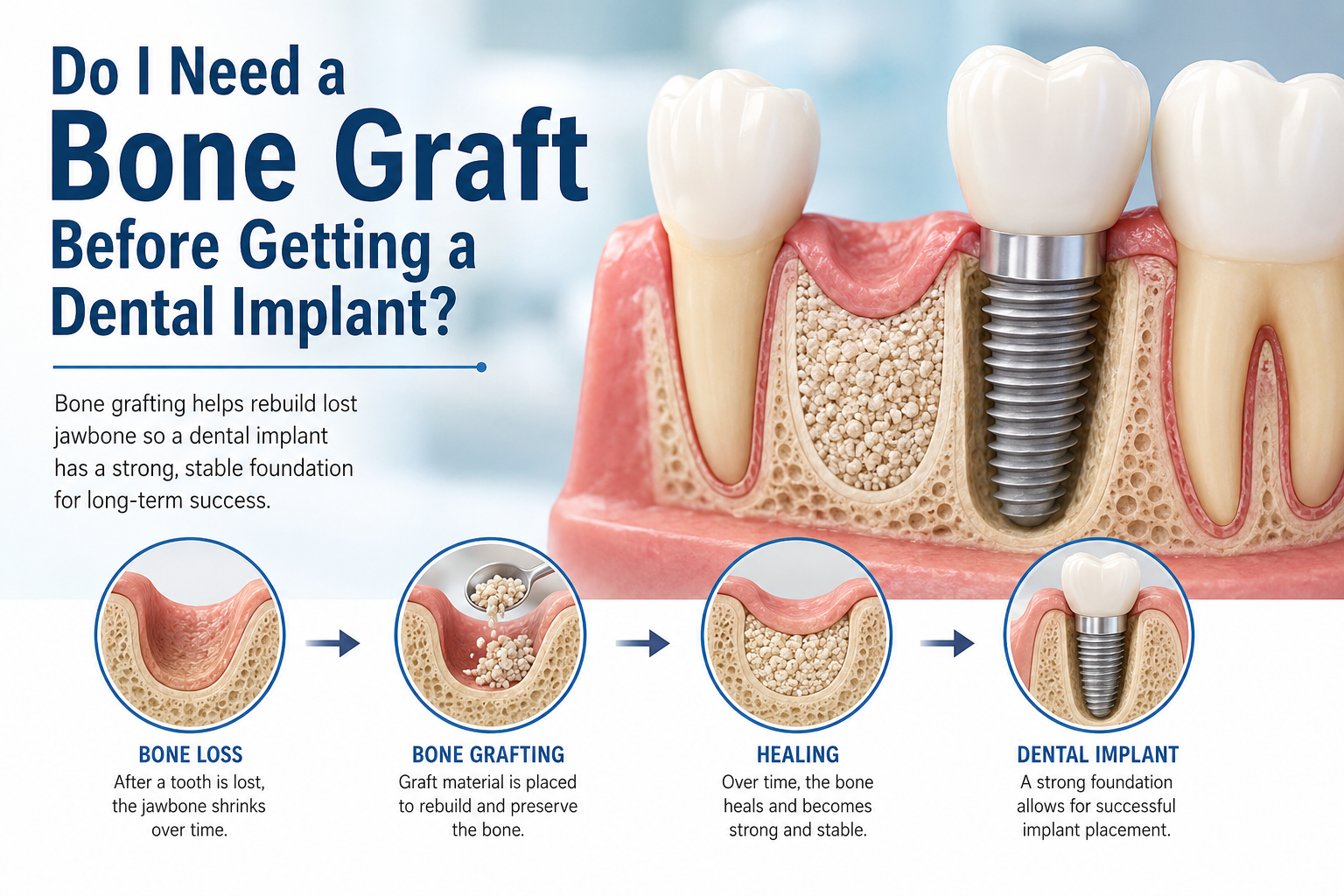
One of the most common questions patients ask after learning they need a dental implant is:
“Will I also need a bone graft?”
The answer depends on your individual situation. Some patients have enough healthy jawbone to support a dental implant right away, while others may benefit from a bone graft before or during implant placement.
The good news is that needing a bone graft is not uncommon, and it does not mean you cannot receive a dental implant. In many cases, bone grafting helps rebuild areas where bone has been lost and creates a more favorable foundation for future implant placement when adequate bone is not present.(1,2,3)
Why Is Bone Important for a Dental Implant?
Think of a dental implant as replacing the root of a natural tooth. Because it is placed directly into the jawbone, it relies on healthy bone for stability and long-term support.
After a tooth is lost or removed, the jawbone in that area naturally begins to shrink. This process, called alveolar ridge resorption, is a normal part of healing and can reduce both the height and width of the bone over time.¹
If too much bone has been lost, there may not be enough support to safely place an implant without first rebuilding the area.
Does Everyone Need a Bone Graft?
No.
Many patients have enough healthy bone to receive a dental implant without additional procedures. Every patient is different, so there is no one-size-fits-all answer. Your need for a bone graft will depend on several factors that your oral surgeon evaluates during your consultation, including:
How much healthy jawbone remains in the area where the implant will be placed
How long the tooth has been missing
Which tooth is being replaced and where it is located in the mouth
Whether bone has been affected by gum disease or previous infection
The condition of the surrounding teeth and gums
Your overall health and your body’s ability to heal
A comprehensive examination and three-dimensional imaging allow your oral surgeon to evaluate these factors and determine whether bone grafting is recommended as part of your treatment plan.
Every patient heals differently, which is why a comprehensive clinical evaluation and three-dimensional imaging are important parts of planning dental implant treatment.
How Does My Oral Surgeon Know If I Need a Bone Graft?
Modern oral surgery relies heavily on cone beam computed tomography (CBCT) imaging.
Unlike a traditional dental X-ray, a CBCT scan allows your oral surgeon to evaluate the jaw in three dimensions. This makes it possible to measure the height, width, and quality of the available bone before treatment begins.
Using this information, your surgeon can determine whether:
A dental implant can be placed immediately
Bone grafting is recommended before implant placement
Bone grafting can be performed at the same time as implant surgery
Careful treatment planning, including a thorough clinical examination and three-dimensional imaging when appropriate, helps your oral surgeon determine the most predictable treatment approach for your individual situation. (4)
What Is a Bone Graft?
A bone graft is a procedure used to rebuild or preserve areas of the jaw where bone has been lost.
During the procedure, bone grafting material is placed into the area that needs additional support. Over time, your body gradually remodels the grafted area, helping preserve or rebuild the bone needed for future implant placement.(2)
Bone grafting materials may come from your own bone, donated human bone, animal-derived sources that have been specially processed for medical use, or synthetic materials. Your oral surgeon will recommend the option that is most appropriate for your specific situation.
Can Bone Grafting Be Done at the Same Time as an Implant?
Sometimes.
If there is only a small amount of bone loss and the implant can achieve good initial stability, bone grafting and implant placement may be performed during the same procedure.
In other situations, especially when bone loss is more extensive, the graft is allowed to heal first before the implant is placed.
The decision depends on the amount of available bone, the location of the implant, and your individual treatment plan.(2,4)
Does a Bone Graft Improve Implant Treatment?
Bone grafting is not performed simply because bone has been lost. Instead, it is recommended when there is not enough healthy bone to allow predictable implant placement or ideal implant positioning.(2,4)
Research has shown that ridge preservation and bone augmentation procedures help preserve or rebuild bone dimensions following tooth loss and facilitate placement of dental implants in more ideal positions.(2,4)
Your oral surgeon will recommend bone grafting only when it is expected to improve the predictability of implant placement and support a stable, long-term foundation for your restoration.
Does Bone Grafting Make Recovery More Difficult?
Recovery after bone grafting is often similar to recovery following many other routine oral surgery procedures.
Some swelling, mild discomfort, and temporary dietary changes are common during the first several days. Most patients are able to return to normal daily activities relatively quickly, although complete healing of the grafted bone typically requires several months. Dr. Platt will provide detailed instructions to help the area heal properly before implant placement.
What Happens If I Decide Not to Have a Bone Graft?
Not every patient who declines bone grafting will be unable to receive a dental implant. However, if there is not enough healthy bone to support the implant, placing one may not be predictable or advisable.
In some situations, alternative treatment options may be discussed. In others, delaying grafting may allow additional bone loss to occur, potentially making future treatment more complex. An evaluation with an oral surgeon can help you understand the benefits and limitations of each option based on your individual needs.
The Bottom Line
Not everyone needs a bone graft before getting a dental implant. However, when there is not enough healthy jawbone to support an implant, bone grafting can help rebuild the foundation needed for predictable implant placement and long-term function.(2,4)
Modern imaging and careful treatment planning allow oral surgeons to evaluate the amount of available bone and develop a treatment plan tailored to each patient. Whether you need an implant alone or an implant with bone grafting, the goal is the same—to provide a stable, healthy, and long-lasting replacement for your missing tooth.
At Jay Platt, DDS Oral Surgery and Dental Implant Center, every implant consultation includes a thorough evaluation of your oral health, jawbone, and treatment goals. If you have been told you may need a bone graft before getting a dental implant, our team can help you understand your options and recommend the treatment plan that is right for you. Contact us today to set up your free consultation
Related Readings
Your Smile Restored: The Dental Implant Process With Dr. Jay Platt
The Importance of Dental Implant Site Preparation in Long-Term Success
Dental Implants: A New Age Solution to an Age Old problem
References
- Tan WL, Wong TL, Wong MCM, Lang NP. A systematic review of post-extractional alveolar hard and soft tissue dimensional changes in humans. Clin Oral Implants Res. 2012;23(suppl 5):1-21. doi:10.1111/j.1600-0501.2011.02375.x.
- Avila-Ortiz G, Elangovan S, Kramer KWO, Blanchette D, Dawson DV. Effect of alveolar ridge preservation after tooth extraction: a systematic review and meta-analysis. J Dent Res. 2014;93(10):950-958. doi:10.1177/0022034514541127.
- Urban IA, Monje A, Lozada JL, Wang HL. Principles for vertical ridge augmentation in the atrophic posterior mandible: a technical review. Int J Periodontics Restorative Dent. 2017;37(5):639-645.
- Buser D, Martin W, Belser UC. Optimizing esthetics for implant restorations in the anterior maxilla: anatomic and surgical considerations. Int J Oral Maxillofac Implants. 2004;19(suppl):43-61.
Comments are closed.