
What Are Full-Arch Dental Implants? A Step-by-Step Guide to Replacing a Full Set of Teeth
 Losing most or all of your teeth can affect much more than your smile. It can change the foods you eat, how comfortably you speak, and how confident you feel in everyday situations.
For many years, removable dentures have been one of the primary ways to replace a complete set of missing teeth. Today, dental implants provide another option. Multiple implants can be used together to support a complete set of replacement teeth, a treatment commonly known as full-arch dental implant rehabilitation.
Full-arch implant rehabilitation is an established treatment option for appropriately selected patients who have lost all of the teeth in an upper or lower arch.¹,²
But full-arch treatment involves much more than simply placing a few implants. The process requires careful evaluation, surgical planning, restorative planning, healing, and long-term maintenance.
So, what should patients expect?
What Are Full-Arch Dental Implants?
Dental implants are placed in the jaw to provide support for replacement teeth. When only one tooth is missing, an implant may be used to support an individual replacement tooth.
Full-arch treatment works differently.
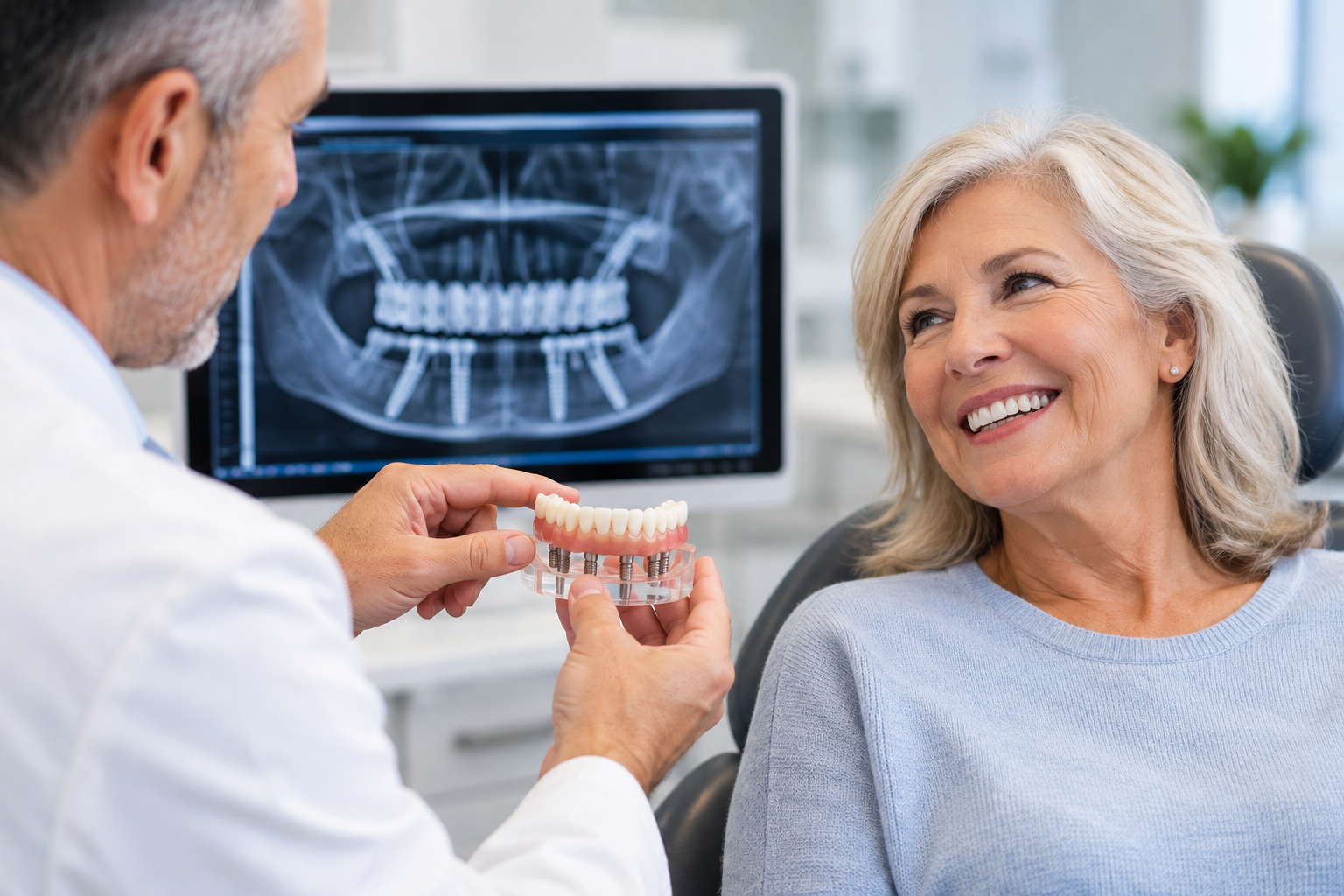
Instead of attempting to replace every missing tooth with its own implant, multiple implants are positioned throughout the jaw to support a complete dental prosthesis.
There is also more than one way to position those implants. Depending on the patient’s anatomy and treatment plan, implants may be positioned vertically or some may be placed at an angle.
A systematic review and meta-analysis evaluating fixed full-arch restorations supported by axial and tilted implants included 24 studies and 2,637 patients. Across follow-up periods ranging from 3 to 18 years, the researchers reported cumulative survival rates of 93.91% for implants and 99.31% for prostheses.³
Those numbers are encouraging, but they do not mean that one implant configuration is appropriate for everyone.
Who May Be a Candidate for Full-Arch Dental Implants?
Full-arch implant treatment may be considered for patients who have already lost all of the teeth in an arch or are facing complete tooth loss.
However, the number of missing teeth is only part of the evaluation.
Treatment planning for an edentulous patient can involve medical factors, the condition of the mouth, available bone, the planned restoration, and other individual considerations. Consensus recommendations for full-arch rehabilitation emphasize evaluating these factors when determining an appropriate treatment approach.¹,²
This is why full-arch treatment should not begin by deciding how many implants a patient is going to receive.
It should begin by evaluating the patient.
Step 1: The Consultation and Evaluation
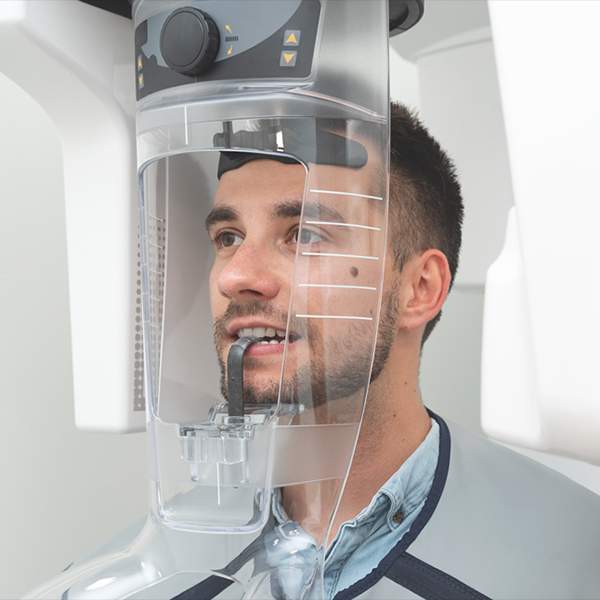
The first step is a comprehensive examination.
Your oral surgeon needs to understand what is happening not only with the teeth you can see, but also with the gums, jawbone, and surrounding anatomy.
Your medical history matters too.
Medical and geriatric factors are among the considerations specifically addressed in consensus recommendations for implant-supported full-arch rehabilitation.¹ More recent consensus recommendations also emphasize periodontal and systemic risk assessment as part of full-arch treatment planning.²
The information gathered during this evaluation helps the treatment team determine whether implant treatment is appropriate and begin developing a plan around the individual patient.
Step 2: Planning the Implants and the New Teeth
One of the first questions many patients ask is:
“How many implants will I need?”
There isn’t one number that is right for everyone.
The number, distribution, and position of implants can vary depending on the treatment plan. Current consensus recommendations specifically address questions involving implant number, tilted versus axial implants, bone regeneration, prosthetic materials, and individual risk factors.²
Research has also evaluated both tilted and vertically positioned implants in full-arch treatment. Del Fabbro and colleagues found high long-term survival for fixed full-arch rehabilitation involving both tilted and axial implants.³
Rather than focusing on a particular number of implants advertised for a procedure, the more important question is:
What implant configuration makes sense for the patient’s anatomy and planned restoration?
Step 3: Evaluating the Available Bone
Dental implants rely on the jaw for support, making the available bone an important part of treatment planning.
Some patients have adequate bone for the proposed treatment, while others may require a different surgical approach or bone augmentation.
That does not mean every full-arch patient needs a bone graft.
The 2026 Italian Consensus Conference specifically addressed guided bone regeneration in full-arch implant rehabilitation and emphasized technique-specific indications rather than treating bone regeneration as a universal requirement.²
The need for grafting therefore depends on the patient’s anatomy and proposed treatment.
Step 4: Placing the Dental Implants
Once the treatment has been planned, the implants are surgically positioned in the jaw.
These implants create the foundation that will support the replacement teeth.
What happens after implant placement can vary significantly from patient to patient.
One option in selected cases is immediate loading, in which a fixed prosthesis is connected to the implants shortly after they are placed.
A systematic review specifically examining immediate loading with fixed prostheses in completely edentulous upper jaws included 33 studies, 2,635 patients, and 12,480 implants. The researchers reported a weighted cumulative implant survival rate of 95.53% for immediately loaded implants.⁴
Importantly, the researchers found no statistically significant difference in implant survival or marginal bone loss between immediate and conventional loading in their analysis. However, they also cautioned that the evidence included no randomized controlled trials and that the available studies were heterogeneous.⁴
In other words, immediate loading can be an option in appropriately selected patients, but it should not be assumed to be appropriate for everyone.
Can You Really Get “Teeth in a Day”?
This is one of the most common questions surrounding full-arch dental implants.
The answer requires some clarification.
The phrase “teeth in a day” generally refers to an immediate-loading approach in which a fixed restoration is connected to newly placed implants shortly after surgery.
Research supports immediate loading as a treatment option in appropriately selected patients. For example, the systematic review discussed above found high implant survival among immediately loaded implants supporting fixed prostheses in completely edentulous upper jaws.⁴
But that does not mean every patient is a candidate for immediate loading.
It also does not mean that all of the biological healing associated with implant surgery happens in one day.
The decision to immediately load implants should be based on the clinical circumstances rather than simply a desire to complete treatment as quickly as possible.⁴
Step 5: Healing After Implant Placement
Even when replacement teeth can be connected shortly after surgery, healing is still taking place beneath the surface.
Immediate loading describes when the restoration is connected to the implants. It does not eliminate the healing process following implant placement.
This distinction is important because full-arch implant treatment is not simply about how quickly teeth can be attached.
The ultimate goal is to create a treatment that can function successfully over time.
That is one reason patient selection and treatment planning remain so important when immediate loading is being considered.⁴
Step 6: Completing the Full-Arch Restoration
Full-arch implant treatment combines surgical and restorative care.
The implants need to be positioned so that they can appropriately support the planned replacement teeth. At the same time, the restoration must be designed with factors such as function, available space, materials, and the patient’s individual situation in mind.
The Oral Reconstruction Foundation consensus specifically examined material selection, interarch space, opposing dentition, and different approaches to rehabilitation of the edentulous upper and lower jaws.¹
More recent consensus recommendations have continued to address prosthetic material selection as an important part of full-arch rehabilitation.²
This is why the surgical and restorative portions of treatment should be considered together rather than as completely separate procedures.
How Are Full-Arch Dental Implants Different From Traditional Dentures?
Both approaches can replace a complete set of missing teeth, but they do not function in exactly the same way.
Traditional complete dentures are removable. Fixed full-arch restorations are supported by dental implants and designed to remain attached during normal daily use.
Research also suggests meaningful benefits from implant-supported treatment for patients who have lost all of their teeth.
A 2023 International Team for Implantology consensus report evaluated evidence from three systematic reviews examining patient-reported outcomes, orofacial function, and preservation of oral tissues following implant treatment.⁵
The consensus concluded that completely edentulous patients treated with complete implant-supported fixed prostheses or implant overdentures experienced substantial improvements in patient-reported outcomes and orofacial function compared with conventional complete dentures.⁵
That does not mean an implant-supported fixed restoration is automatically the best option for every patient. It means implant-supported treatment provides another evidence-based option that can be considered when replacing a complete arch of missing teeth.
Do Full-Arch Dental Implants Require Maintenance?
Yes.
Dental implant treatment does not end when the new teeth are placed.
The implants, surrounding tissues, and prosthesis require ongoing care. The 2026 full-arch consensus specifically includes risk-stratified supportive maintenance, meaning maintenance recommendations should consider the individual patient’s risk factors.²
Patients considering full-arch treatment should therefore think about long-term maintenance as part of the treatment rather than something that becomes important only if a problem develops.
Are Full-Arch Dental Implants Right for Everyone?
No single tooth-replacement option is appropriate for every patient.
Full-arch dental implants may provide an option for patients who have lost all of their teeth in an arch or are facing complete tooth loss, but treatment needs to be individualized.
Some patients may be candidates for immediate loading, while others may benefit from a different approach. Some may need bone augmentation, while others may not. The number and position of implants can also differ among patients.¹⁻⁴
These differences are exactly why a comprehensive evaluation is so important.
The goal isn’t to fit every patient into a particular full-arch technique.
The goal is to determine which treatment approach makes sense for that patient.
The Bottom Line
Full-arch dental implant treatment uses multiple dental implants to support a complete set of replacement teeth.
Research demonstrates favorable long-term outcomes for fixed full-arch rehabilitation, including high survival of both implants and prostheses in the studies included in systematic reviews.³ Immediate loading can also provide favorable outcomes in appropriately selected patients, although the evidence has limitations and should not be interpreted as meaning immediate treatment is right for everyone.⁴
Most importantly, full-arch treatment should not be reduced to a particular number of implants or a promise of getting “teeth in a day.”
Successful treatment begins with evaluating the patient, understanding the available anatomy and individual risk factors, planning the implants and restoration together, and developing a treatment approach appropriate for that person’s needs.¹,²
At Jay Platt, DDS Oral Surgery and Dental Implant Center, full-arch treatment begins with a careful evaluation rather than a one-size-fits-all procedure. If you are struggling with missing teeth, failing teeth, or uncomfortable dentures, a consultation can help determine whether full-arch dental implant treatment may be an option for you.
Read Next: What Can Cause a Dental Implant to Fail? Understanding the Risk Factors
Related Articles:
A New Year, A Stronger Smile: Understanding Full Arch Dental Implants
The Benefits of Digital Workflows for Full Arch Dental Implant Procedures
Full Arch Dental Implants: The Future is Now
References
1. Schwarz F, Schär A, Nelson K, et al. Recommendations for implant-supported full-arch rehabilitations in edentulous patients: the Oral Reconstruction Foundation consensus report. Int J Prosthodont. 2021;34(suppl):s8-s20. doi:10.11607/ijp.consensusreport.
PubMed: Schwarz et al.
2. Rapone B, Ferrara E, Tomarelli F, et al. Consensus statement on full-arch implant rehabilitations: evidence-based recommendations from the Italian Consensus Conference. J Clin Med. 2026;15(10):3695. doi:10.3390/jcm15103695.
Full text: Rapone et al.
3. Del Fabbro M, Pozzi A, Romeo D, de Araújo Nobre M, Agliardi E. Outcomes of fixed full-arch rehabilitations supported by tilted and axially placed implants: a systematic review and meta-analysis. Int J Oral Maxillofac Implants.2022;37(5):1003-1025. doi:10.11607/jomi.9710.
PubMed: Del Fabbro et al.
4. Jiang X, Zhou W, Wu Y, Wang F. Clinical outcomes of immediate implant loading with fixed prostheses in edentulous maxillae: a systematic review. Int J Oral Maxillofac Implants. 2021;36(3):503-519. doi:10.11607/jomi.8509.
PubMed: Jiang et al.
5. Schimmel M, Araujo M, Abou-Ayash S, et al. Group 4 ITI Consensus Report: Patient benefits following implant treatment in partially and fully edentulous patients. Clin Oral Implants Res. 2023;34(suppl 26):257-265. doi:10.1111/clr.14145.
PubMed: Schimmel et al.
Comments are closed.