

Can You Get Dental Implants If You Have Gum Disease? What Patients Need to Know
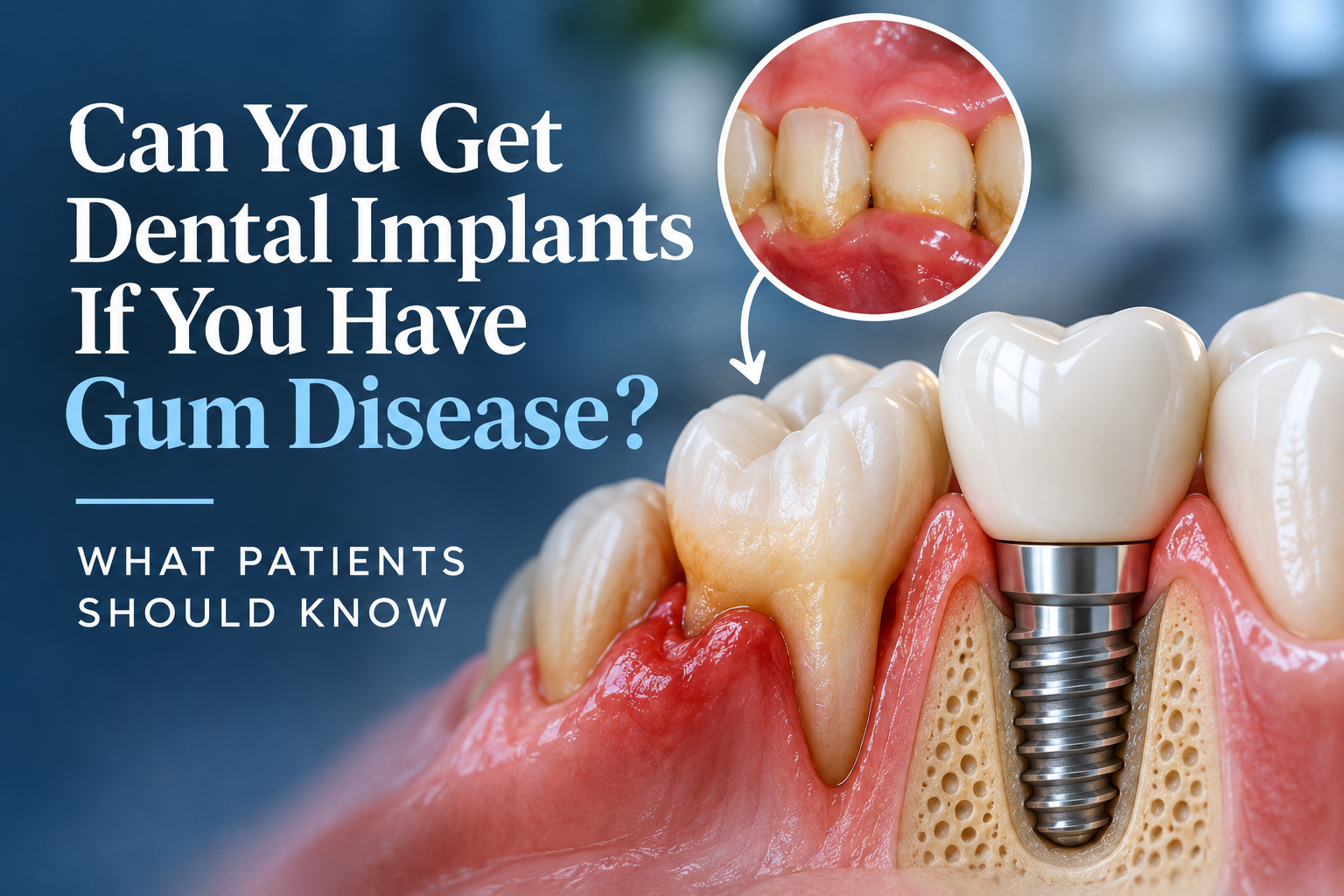
If you’ve lost a tooth because of gum disease, you may be wondering whether replacing it with a dental implant is even possible. It’s a reasonable concern. After all, the same jawbone that once held your natural tooth would now need to support an implant.
The answer isn’t always straightforward, but having gum disease doesn’t necessarily close the door on dental implants.
What matters is how much damage has occurred, whether the disease is still active, and what can be done to create a healthy environment for your replacement teeth.
Can I Get Dental Implants if I’ve Had Gum Disease?
There is a difference between having a history of gum disease and having ongoing inflammation that hasn’t been treated.
Consider two patients. One lost a tooth several years ago because of periodontal disease but has since maintained healthy gums. Another is currently experiencing bleeding gums, deep periodontal pockets, and continuing bone loss.
Although both have a history of gum disease, their treatment needs may be very different.
Clinical guidelines recommend addressing periodontal inflammation and evaluating the condition of the remaining teeth and supporting tissues before proceeding with definitive implant treatment.¹
What Happens to the Jawbone When You Have Gum Disease?
Your natural teeth are held in place by a network of bone and surrounding tissues. Advanced gum disease, called periodontitis, gradually damages these supporting structures.
As the disease progresses, teeth may loosen or eventually require removal.
For someone considering dental implants, the amount of bone remaining becomes an important part of the conversation.
An oral surgeon needs to determine whether the proposed implant location has enough bone to support the replacement tooth. That evaluation also considers the shape of the bone and the condition of the nearby gums.
In some cases, bone grafting may be recommended. In others, the existing anatomy may allow treatment without grafting.¹
Will My Previous Gum Disease Affect My New Implants?
This is where understanding your dental history becomes especially important.
Researchers have followed patients with and without previous periodontal disease to see how their implants performed over time.
A 2024 systematic review examined 12 prospective studies involving 4,425 implants. Patients with a history of periodontitis experienced greater risks of implant loss and complications involving the surrounding tissues.³
In a smaller analysis of five studies involving 884 implants, peri-implantitis occurred approximately four times as frequently among patients with a history of periodontitis compared with those without that history.³
These findings don’t mean that implants are destined to fail after gum disease. They do mean that your previous periodontal health deserves consideration when planning treatment and follow-up care.
Can Gum Disease Come Back Around an Implant?
Not in exactly the same form.
Periodontitis affects the structures supporting natural teeth. Once a tooth has been replaced with an implant, the surrounding tissues have a different attachment to the replacement.
However, those tissues can still develop inflammation.
An early condition called peri-implant mucositis affects the soft tissue around an implant. A more serious condition, peri-implantitis, involves inflammation accompanied by progressive loss of supporting bone.²
This distinction matters because replacing a tooth doesn’t remove the possibility of future problems in the surrounding gums and bone.
Do I Have to Wait Until My Gums Are Healthy?
For many patients, controlling active periodontal disease comes before implant placement.
That might mean having periodontal treatment, improving cleaning habits, and returning for an examination to see how the gums have responded.
Rather than following one timeline for everyone, the dental team evaluates whether the mouth is ready for the next stage of treatment.
For patients replacing individual teeth, periodontal treatment generally needs to be completed successfully before implants are placed. However, patients requiring full-arch rehabilitation may follow a different treatment sequence, particularly when the remaining teeth cannot be saved.¹
What if Gum Disease Has Affected All My Teeth?
Losing multiple teeth can make the decision feel more complicated, but it doesn’t necessarily eliminate implant-supported restorations.
Some patients with severe periodontal damage may be candidates for full-arch treatment, in which several implants support an entire arch of replacement teeth.
However, this isn’t automatically the best choice for every patient.
An oral surgeon must evaluate which teeth can reasonably be preserved, how much supporting bone remains, and whether implant placement would provide a suitable foundation for a full-arch restoration.
Preserving natural teeth is generally preferred when they can be successfully treated and maintained. For patients whose remaining teeth cannot be saved, implant-supported full-arch treatment may be an option, provided the necessary anatomical and clinical conditions are met.¹
What Should I Do Before Considering Dental Implants?
Start by understanding the current condition of your mouth rather than assuming that a previous gum disease diagnosis determines your future options.
An implant consultation can help answer several practical questions: Is periodontal disease still active? How much supporting bone remains? Would additional treatment be beneficial? What type of replacement would be appropriate?
Long-term care also deserves attention. Even after successful implant placement, regular professional monitoring and daily cleaning remain important, particularly for people with a history of periodontal disease.¹,²
The Bottom Line
Gum disease can make dental implant treatment more complicated, but it doesn’t automatically make it impossible.
The important first step is determining whether your gums are stable, how much bone remains, and which treatment approach makes sense for your situation.
At Jay Platt, DDS Oral Surgery and Dental Implant Center in Schererville, Indiana, we help patients explore tooth replacement options based on their individual needs.
If you’ve lost teeth because of gum disease and want to know whether dental implants may be an option, schedule a consultation to discuss your next steps.
References
- Herrera D, Sanz M, Kebschull M, et al. Treatment of stage IV periodontitis: the EFP S3 level clinical practice guideline. J Clin Periodontol. 2022;49(suppl 24):4-71. doi:10.1111/jcpe.13639. https://pubmed.ncbi.nlm.nih.gov/35688447/
- Berglundh T, Armitage G, Araujo MG, et al. Peri-implant diseases and conditions: consensus report of Workgroup 4 of the 2017 World Workshop on the Classification of Periodontal and Peri-Implant Diseases and Conditions. J Clin Periodontol. 2018;45(suppl 20). doi:10.1111/jcpe.12957. https://pubmed.ncbi.nlm.nih.gov/29926491/
- Serroni M, Borgnakke WS, Romano L, et al. History of periodontitis as a risk factor for implant failure and incidence of peri-implantitis: a systematic review, meta-analysis, and trial sequential analysis of prospective cohort studies. Clin Implant Dent Relat Res. 2024;26(3):482-508. doi:10.1111/cid.13330. https://pubmed.ncbi.nlm.nih.gov/38720611/
Comments are closed.