
What Can Cause a Dental Implant to Fail? Understanding the Risk Factors
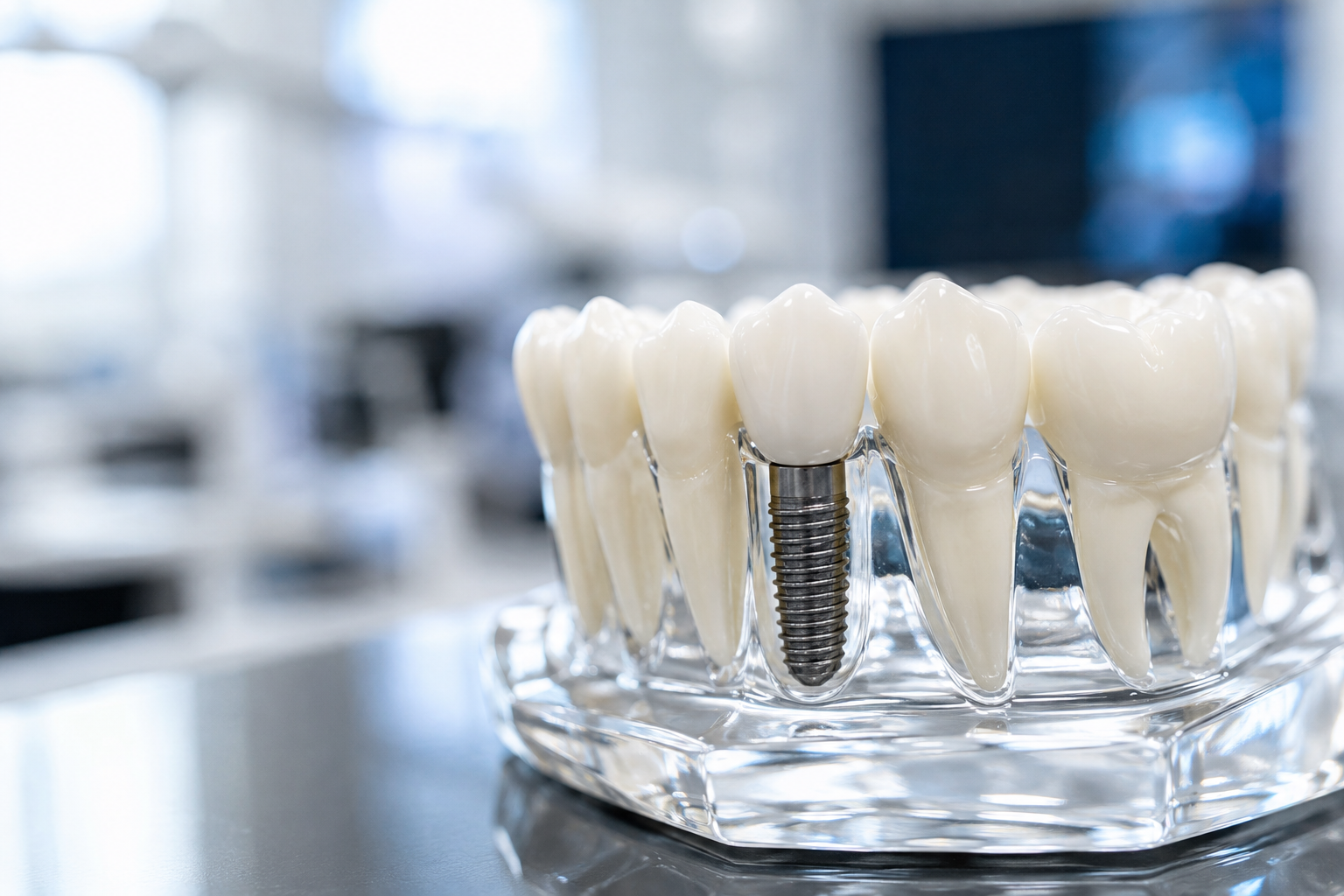
Dental implants have excellent long-term survival rates and can provide many years of reliable function for patients who are missing teeth. Large systematic reviews have found that the vast majority of implants studied remain in place after 10 years, and newer research has documented favorable outcomes extending to 20 years.¹⁻³
Still, no medical or dental treatment can be guaranteed to last forever. Dental implant complications can occur, and certain health, lifestyle, and oral conditions may increase the risk.
Understanding these risk factors is important because some can be identified and addressed before implant placement, while others can be managed through good home care and regular professional maintenance.
How Common Is Dental Implant Failure?
Dental implant failure is relatively uncommon.
A systematic review of studies with at least 10 years of follow-up reported a cumulative mean implant survival rate of 94.6%.¹ Another systematic review examining 10-year survival also found high long-term survival, while a 2024 meta-analysis evaluated implant survival extending as far as 20 years.²,³
It is important to understand that implant survival and implant success are not exactly the same thing. An implant may remain in place but still develop biological or mechanical complications that require treatment.
Rather than focusing only on whether an implant can fail, it can be more helpful for patients to understand the factors that may affect the health of an implant over time.
Risk Factor #1: Smoking
Smoking is one of the better-established risk factors associated with dental implant failure.
A systematic review and meta-analysis found that smokers experienced a significantly greater risk of implant failure than nonsmokers. The researchers also found greater marginal bone loss around implants among smokers.⁴
For patients who smoke or use tobacco products, discussing tobacco use with the oral surgeon before implant treatment is an important part of evaluating individual risk.
Risk Factor #2: Diabetes
Having diabetes does not automatically mean that you cannot receive a dental implant. However, diabetes is an important part of a patient’s medical history and should be considered during implant treatment planning.
A 2022 systematic review and meta-analysis found a higher implant failure rate and greater marginal bone loss in patients with diabetes compared with patients without diabetes.⁵
The relationship between diabetes and implant outcomes is complex, and individual factors—including a patient’s overall medical status and diabetes management—should be considered when planning treatment.
Risk Factor #3: Inadequate Bone
Dental implants depend on the surrounding jawbone for support. When there is not enough bone to place an implant in an appropriate position, bone augmentation may be considered before or during implant treatment.
Bone loss can occur for several reasons, including changes that occur after a tooth is removed, periodontal disease, trauma, or other conditions affecting the jaw.
Importantly, inadequate bone does not necessarily mean that dental implant treatment is impossible. A 2024 systematic review and meta-analysis found high long-term implant survival rates in areas that had undergone reconstruction with extraoral autogenous bone grafts, although the procedures evaluated involved significant reconstruction and should not be considered equivalent to every type of dental bone graft.⁶
An oral surgeon can evaluate the amount and location of available bone and determine whether grafting or another treatment approach is appropriate.
Risk Factor #4: Peri-Implant Disease
The tissues surrounding an implant need to remain healthy just like the tissues surrounding natural teeth.
Peri-implant mucositis is an inflammatory condition affecting the soft tissues around an implant. Dental biofilm is the primary cause, and evidence shows that biofilm-induced peri-implant mucositis can improve when effective plaque control is restored.⁷,⁸
Peri-implantitis is different. It is a plaque-associated condition characterized by inflammation around the implant together with progressive loss of supporting bone.⁷
Poor plaque control and lack of regular maintenance have been associated with a greater risk of peri-implant disease.⁷ Keeping the tissues surrounding an implant healthy is therefore an important part of protecting it over time.
Risk Factor #5: Teeth Grinding and Clenching
Grinding or clenching the teeth, also known as bruxism, may increase the risk of problems involving dental implants and implant-supported restorations.
A recent systematic review and meta-analysis found higher implant failure rates among patients with bruxism. The authors also identified bruxism as a probable risk factor for mechanical problems involving implant-supported prostheses and crowns.⁹
Bruxism does not necessarily mean a patient cannot receive dental implants. Instead, it is another factor the dental team should consider when planning the implant and the restoration attached to it.
Risk Factor #6: Poor Plaque Control and Inconsistent Maintenance
Dental implants cannot develop cavities, but the tissues surrounding them can develop inflammation and disease.
That makes both home care and professional maintenance important after implant treatment.
A 2026 systematic review evaluating supportive peri-implant therapy found that individualized, risk-based maintenance was associated with better clinical outcomes than standard or no maintenance. The review emphasized professional care together with maintenance strategies tailored to the patient’s individual risk factors.¹⁰
Regular follow-up also gives the dental team an opportunity to evaluate the implant, surrounding gums, bone levels, and restoration over time.
Risk Factor #7: Certain Medications and Medical Treatments
Your complete medical history matters when planning dental implant surgery.
One important example involves antiresorptive medications, which may be prescribed for osteoporosis or used as part of the treatment of certain cancers.
The American Association of Oral and Maxillofacial Surgeons recognizes medication-related osteonecrosis of the jaw as an important consideration in patients receiving antiresorptive and certain other therapies. Treatment planning should consider factors such as the medication being used, why the patient is receiving it, duration of therapy, other medications, and individual health factors.¹¹
If you take medication for osteoporosis, cancer, or another condition affecting bone metabolism, make sure your oral surgeon knows before implant treatment is planned. Never stop a prescribed medication unless the clinician managing that medication instructs you to do so.
Can Problems With a Dental Implant Be Treated?
Sometimes. Developing a problem around an implant does not automatically mean that the implant has to be removed.
For example, biofilm-induced peri-implant mucositis can improve when effective plaque control is restored.⁸ Treatment of peri-implantitis may also help control inflammation and disease progression, although treatment becomes more complex once supporting bone has been lost.⁷
The appropriate treatment depends on what is causing the problem, how advanced it has become, the stability and position of the implant, the amount of remaining bone, and the patient’s overall health.
This is another reason it is important not to ignore changes around an implant.
Bleeding, swelling, discomfort, drainage, changes in the gum tissue, or a feeling that an implant or its restoration is loose should be evaluated by a dental professional.
How Can You Reduce Your Risk of Implant Problems?
No patient can completely eliminate the possibility of an implant complication, but several factors associated with long-term implant health can be addressed.
Good plaque control at home and regular professional maintenance are particularly important because dental biofilm is associated with peri-implant inflammation, and evidence supports ongoing supportive peri-implant care.⁷,⁸,¹⁰
Patients should also make sure their oral surgeon has an accurate medical and medication history and knows about factors such as smoking, diabetes, teeth grinding or clenching, and previous problems with the teeth or gums.⁴,⁵,⁹,¹¹
The goal is not simply to place an implant. It is to identify potential risks, plan treatment appropriately, and maintain the implant and surrounding tissues over time.
The Bottom Line
Dental implants have excellent long-term survival rates, but successful treatment depends on more than the implant itself.¹⁻³
Smoking, diabetes, inadequate bone, peri-implant disease, bruxism, poor plaque control, inconsistent maintenance, and certain medications or medical treatments can all influence implant treatment or long-term outcomes.⁴⁻¹¹
Some of these factors can be modified, while others simply need to be recognized and considered during treatment planning. A thorough evaluation allows your oral surgeon to identify potential concerns and develop an implant treatment plan based on your individual health and anatomy.
At Jay Platt, DDS Oral Surgery and Dental Implant Center, every dental implant treatment plan begins with a careful evaluation of the patient, the proposed implant site, and factors that could affect treatment. If you are considering dental implants—or are concerned about an implant you already have—our team can evaluate your situation and help determine the appropriate next step.
References
- Moraschini V, Poubel LA, Ferreira VF, Barboza ESP. Evaluation of survival and success rates of dental implants reported in longitudinal studies with a follow-up period of at least 10 years: a systematic review. Int J Oral Maxillofac Surg. 2015;44(3):377-388. doi:10.1016/j.ijom.2014.10.023.
- Howe MS, Keys W, Richards D. Long-term (10-year) dental implant survival: a systematic review and sensitivity meta-analysis. J Dent. 2019;84:9-21. doi:10.1016/j.jdent.2019.03.008.
- Kupka JR, König J, Al-Nawas B, Sagheb K, Schiegnitz E. How far can we go? A 20-year meta-analysis of dental implant survival rates. Clin Oral Investig. 2024;28(10):541. doi:10.1007/s00784-024-05929-3.
- Mustapha AD, Salame Z, Chrcanovic BR. Smoking and dental implants: a systematic review and meta-analysis. Medicina (Kaunas). 2022;58(1):39. doi:10.3390/medicina58010039.
- Al Ansari Y, Shahwan H, Chrcanovic BR. Diabetes mellitus and dental implants: a systematic review and meta-analysis. Materials (Basel). 2022;15(9):3227. doi:10.3390/ma15093227.
- Moraschini V, Louro RS, Son A, Calasans-Maia MD, Sartoretto SC, Shibli JA. Long-term survival and success rate of dental implants placed in reconstructed areas with extraoral autogenous bone grafts: a systematic review and meta-analysis. Clin Implant Dent Relat Res. 2024;26(3):469-481. doi:10.1111/cid.13319.
- Berglundh T, Armitage G, Araujo MG, et al. Peri-implant diseases and conditions: consensus report of Workgroup 4 of the 2017 World Workshop on the Classification of Periodontal and Peri-Implant Diseases and Conditions. J Clin Periodontol. 2018;45(suppl 20):S286-S291. doi:10.1111/jcpe.12957.
- Heitz-Mayfield LJA, Salvi GE. Peri-implant mucositis. J Clin Periodontol. 2018;45(suppl 20):S237-S245. doi:10.1111/jcpe.12953.
- Ionfrida JA, Stiller HL, Kämmerer PW, Walter C. Dental implant failure risk in patients with bruxism—a systematic review and meta-analysis of the literature. Dent J (Basel). 2025;13(1):11. doi:10.3390/dj13010011.
- Mojaver S, Zad A, Sarmiento H, Fiorellini JP. Efficacy of supportive peri-implant therapy in the management of peri-implant mucositis and peri-implantitis: a systematic review. J Am Dent Assoc. 2026;157(2):141-152.e4. doi:10.1016/j.adaj.2025.08.015.
- Ruggiero SL, Dodson TB, Aghaloo T, Carlson ER, Ward BB, Kademani D. American Association of Oral and Maxillofacial Surgeons’ position paper on medication-related osteonecrosis of the jaws—2022 update. J Oral Maxillofac Surg. 2022;80(5):920-943. doi:10.1016/j.joms.2022.02.008.
Comments are closed.