

How Long Do Dental Implants Last, Really?
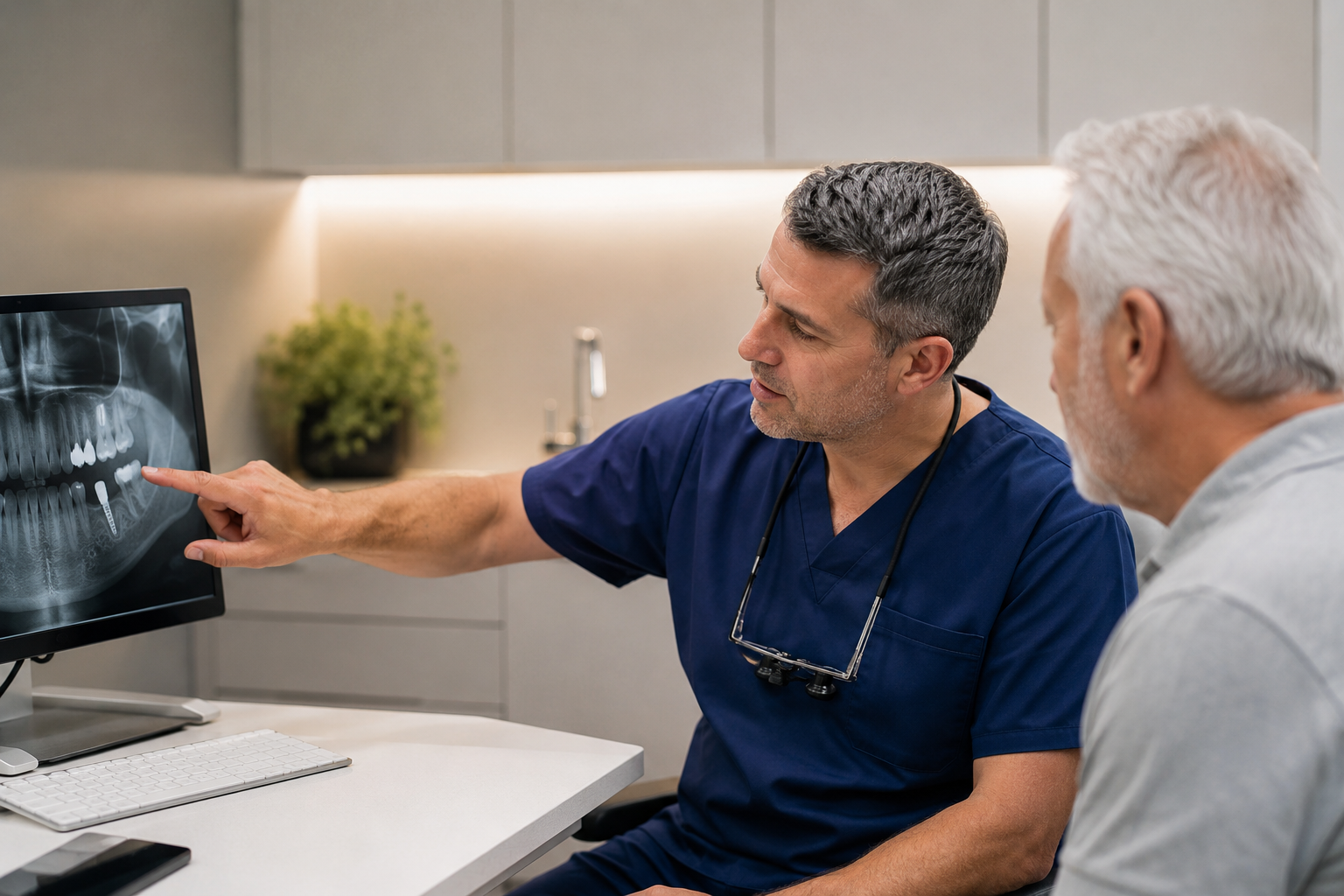
Dental implants have become one of the most reliable ways to replace missing teeth. If you are considering implant treatment, one of the first questions you may ask is, “How long will my dental implant last?”
The answer is encouraging. Dental implants are designed to be a long-term solution for missing teeth, and many patients enjoy successful results for decades. While no medical or dental procedure can be guaranteed to last forever, research has consistently shown that dental implants have excellent long-term outcomes when they are properly placed, cared for, and maintained.¹⁻⁴
What Is a Dental Implant?
A dental implant is a small post that is surgically placed into the jawbone where a tooth is missing. Most implants are made from titanium, although some are made from ceramic materials.
During healing, the surrounding bone forms a close connection with the implant through a process called osseointegration. Once healing is complete, the implant can support a dental crown, bridge, or full arch of replacement teeth.
The implant replaces the root portion of a missing tooth. The crown or other restoration attached to it replaces the visible part of the tooth.
How Long Do Dental Implants Last?
Research shows that dental implants have strong long-term survival rates.
Systematic reviews examining implants for at least 10 years have found that most implants remain in place and continue to function over the long term.¹,² A 2024 meta-analysis specifically examining 20-year outcomes also found that many implants were still functioning after two decades, although survival estimates varied depending on the studies included and how patients lost to follow-up were handled.⁴
These findings support the use of dental implants as a durable treatment, but they do not mean every implant will last for the same amount of time. An implant’s lifespan depends on the patient’s health, the condition of the surrounding tissues, the location of the implant, daily care, and professional maintenance.
Implant Survival and Implant Success Are Not the Same
Researchers often use the terms “survival” and “success” when reporting implant outcomes, but they do not mean exactly the same thing.
An implant is generally considered to have survived if it remains in the mouth and continues to function. Implant success is a broader standard. It may also consider implant stability, comfort, surrounding bone levels, the health of the gum tissue, and whether complications have developed.³
This distinction is important because an implant can remain in place while still requiring treatment for inflammation, bone loss, or a problem with the crown or other restoration.
What Can Affect How Long a Dental Implant Lasts?
Dental implants are highly predictable, but they still depend on healthy tissues and ongoing care.
Oral Hygiene and Professional Maintenance
Plaque can collect around an implant just as it can around a natural tooth. If it is not removed, inflammation may develop in the surrounding gum tissue. Peri-implant mucositis affects the soft tissue around an implant, while peri-implantitis also involves progressive loss of supporting bone.⁵
Daily cleaning and regular professional care allow the tissues around an implant to be monitored and help problems get identified earlier.
Smoking
Smoking is associated with a greater risk of dental implant failure and increased bone loss around implants.
A systematic review and meta-analysis found that implants placed in people who smoked had a higher risk of failure than implants placed in nonsmokers. The review also found greater marginal bone loss among smokers.⁶
Smoking does not automatically prevent someone from receiving an implant, but it is an important risk factor that should be discussed during treatment planning.
Diabetes
Though diabetes does not mean an individual cannot get dental implants, it ceratinly can increase failure risks for a variety of reasons illustrated in the literature.
A systematic review and meta-analysis found that diabetes was associated with a higher risk of implant failure and greater marginal bone loss. The authors also noted that the available studies did not always provide enough information to determine precisely how factors such as blood sugar control affected every outcome.⁷
Patients with diabetes should discuss their current health and blood sugar management with both their physician and oral surgeon before implant treatment.
Bone and Soft-Tissue Health
Dental implants need enough healthy bone for support. The condition of the gum tissue around an implant also matters because it helps protect the area and allows it to be cleaned.
When bone volume is limited, a bone graft or another procedure may be recommended before or during implant placement. Each patient’s needs are different, which is why three-dimensional imaging and an individual evaluation are important parts of planning.
The Position of the Implant and Bite Forces
Implants placed in different areas of the mouth may experience different levels and directions of force. Grinding or clenching can also place added stress on the implant restoration and its components.
Careful planning helps position the implant so forces can be managed appropriately. Patients who grind their teeth may be advised to wear a nightguard to protect the implant crown and other teeth.
Can a Dental Implant Fail?
Yes, although failure is not common.
Early implant failure happens before the implant has formed a stable connection with the surrounding bone. Research has associated early failure with factors such as surgical trauma, local anatomy, impaired healing, infection, and inadequate implant stability.⁸
Late problems occur after an implant has already healed and been placed into function. These may involve peri-implantitis, progressive bone loss, or complications affecting the crown, bridge, screws, or other restorative components.⁵
The cause of implant failure is often not one single issue. Medical health, smoking, bone quality, oral hygiene, implant position, and maintenance may all play a role.
Does the Crown Last as Long as the Implant?
Not necessarily.
The implant is the part positioned inside the jawbone. The crown, bridge, or full-arch restoration attached to it is exposed to chewing forces every day.
Over time, the visible restoration may wear, chip, loosen, or need to be repaired or replaced even when the implant itself remains stable. The lifespan of the restoration depends on its design and materials, the patient’s bite, grinding habits, oral hygiene, and how the implant is maintained.
This is one reason it is helpful to think of an implant as a treatment with several parts rather than as one single device.
Can a Dental Implant Last a Lifetime?
It is possible for a dental implant to remain functional for decades, and some implants may last for the rest of a patient’s life.
The most responsible expectation is that dental implants are a long-term treatment with strong survival rates, but they require care and monitoring. Even a well-placed implant can develop problems if the surrounding tissues become unhealthy or if medical and lifestyle risks change.
How Can You Help Your Implant Last Longer?
Patients play an important role in the long-term health of their implants. Helpful habits include:
- Brushing carefully around the implant every day
- Cleaning between the implant and nearby teeth
- Attending regular dental examinations and professional cleanings
- Avoiding tobacco products
- Managing diabetes and other health conditions
- Wearing a nightguard when recommended
- Reporting bleeding, swelling, pain, or looseness promptly
- Following the maintenance plan recommended by the dental team
The right cleaning tools may vary depending on whether the implant supports one crown, a bridge, or a full arch of teeth. Your dental team can show you how to clean around your specific restoration.
The Bottom Line
Dental implants are among the most durable and predictable options available for replacing missing teeth. Evidence from systematic reviews supports strong survival over 10 years, and newer research shows that many implants can continue functioning for 20 years.¹,²,⁴
Still, longevity is influenced by more than the implant itself. Overall health, smoking, plaque control, the condition of the surrounding bone and gums, bite forces, and regular professional care can all affect the outcome.
At Jay Platt, DDS Oral Surgery and Dental Implant Center, implant treatment is planned around each patient’s health, anatomy, and long-term needs. Whether you need to replace one tooth or are considering a full arch of replacement teeth, a personalized consultation can help you understand your options and the steps that support long-term success. Contact us today to schedule your free consultation
Related Readings
Am I Too Old for Dental Implants? What the Research Says
Dental Implants or Dentures: Which Option is Right for You?
Why Should You Consider Dental Implants?
References
- Moraschini V, Poubel LA, Ferreira VF, Barboza ESP. Evaluation of survival and success rates of dental implants reported in longitudinal studies with a follow-up period of at least 10 years: a systematic review. Int J Oral Maxillofac Surg. 2015;44(3):377-388. doi:10.1016/j.ijom.2014.10.023. https://pubmed.ncbi.nlm.nih.gov/25467739/
- Howe MS, Keys W, Richards D. Long-term (10-year) dental implant survival: a systematic review and sensitivity meta-analysis. J Dent. 2019;84:9-21. doi:10.1016/j.jdent.2019.03.008. https://pubmed.ncbi.nlm.nih.gov/30904559/
- Papaspyridakos P, Chen CJ, Singh M, Weber HP, Gallucci GO. Success criteria in implant dentistry: a systematic review. J Dent Res. 2012;91(3):242-248. doi:10.1177/0022034511431252. https://pubmed.ncbi.nlm.nih.gov/22157097/
- Kupka JR, König J, Al-Nawas B, Sagheb K, Schiegnitz E. How far can we go? A 20-year meta-analysis of dental implant survival rates. Clin Oral Investig. 2024;28(10):541. doi:10.1007/s00784-024-05929-3. https://pmc.ncbi.nlm.nih.gov/articles/PMC11416373/
- Berglundh T, Armitage G, Araujo MG, et al. Peri-implant diseases and conditions: consensus report of Workgroup 4 of the 2017 World Workshop on the Classification of Periodontal and Peri-Implant Diseases and Conditions. J Clin Periodontol. 2018;45(suppl 20). doi:10.1111/jcpe.12957. https://pubmed.ncbi.nlm.nih.gov/29926491/
- Mustapha AD, Salame Z, Chrcanovic BR. Smoking and dental implants: a systematic review and meta-analysis. Medicina (Kaunas). 2022;58(1):39. doi:10.3390/medicina58010039. https://pubmed.ncbi.nlm.nih.gov/35056347/
- Al Ansari Y, Shahwan H, Chrcanovic BR. Diabetes mellitus and dental implants: a systematic review and meta-analysis. Materials (Basel). 2022;15(9):3227. doi:10.3390/ma15093227. https://pubmed.ncbi.nlm.nih.gov/35591561/
- Esposito M, Hirsch JM, Lekholm U, Thomsen P. Biological factors contributing to failures of osseointegrated oral implants. I. Success criteria and epidemiology. Eur J Oral Sci. 1998;106(1):527-551. doi:10.1046/j.0909-8836..t01-2-.x. https://pubmed.ncbi.nlm.nih.gov/9527353/
Comments are closed.